There's a voice in your head that has been narrating your life since you were a kid. You've never chosen it, and you've almost certainly never questioned it.
The adults around you would have influenced it, and everything you do, you do inside what it says is possible. I've called it self-talk, and I don't even know if I've given this voice the power it deserves, because what I'm talking about here is the relationship between the language that we use inside our own heads and the lives we end up creating.
When you hear self-talk, you might think about positive affirmations, motivational statements or telling yourself that you're wonderful, which you are, but what I'm talking about is far more fundamental. It's about what you believe is possible for you. How you interpret what happens to you. What you tell yourself when something goes wrong. Whether you encourage yourself to act or give yourself reasons not to. Whether you see yourself as capable or incapable. Whether you keep going, give up, withdraw or try again. The stories that you repeat about who you are and what your life can be.
Because ultimately the conversation you have with yourself influences the decisions you make, the actions you take and the experiences you create. So that's so much bigger than just saying self-talk. And I'll just repeat that because it's really important to understand: the conversations you have with yourself today, right now, even as you're listening to this, will influence the decisions that you make, the actions that you take, and the experiences that you create.
And so I called that the Self-Talk Effect. But what I'm really trying to explain here is how your inner voice shapes your life, and that the conversations you have with yourself are shaping your life right now. If you change the way you talk to yourself, you change what happens next. The most important conversation you will ever have is the one you have with yourself.
Now, growing up, I was labeled shy. Am I quiet? Yes. I'm not an extrovert. I meet people, I warm up to them, I open up to them. That's my process. Some people I click with instantly. Others I never do. But for the majority, I meet people, I get to know them, I warm up to them. But that doesn't make me shy.
Now, obviously, that's the label I grew up with. It's the first thing everybody said about me because I was quiet and I sat there. So, therefore, I'm shy. And then, of course, I got to school and I discovered what shy means, what it means to be shy. I adopted that label and I kept it for the first 25 years of my life, until I decided to make a change. And it took until maybe I was 30 years old before I recognized I am not shy. I absolutely can hold a conversation with a person. It's just whether I choose to or not. I don't do small talk and I prefer to be open and authentic when I'm speaking, and I only really speak when I have something to say. I'm not going to talk for the sake of it. I'm not a talker. I am a good listener though.
So all that to say that this one label, and trust me, I had many more, dictated the conversations I was having in my head. Should I speak? Should I not speak? Don't say that. They might think you're whatever. X Y Z. That's okay, you're shy, so nobody expects you to speak. These are all the things running through my head when I'm in social situations. And it had an impact on who I believed I was, what I believed I was capable of, what I thought about myself, even the whole conversation about me being ugly. It all stemmed from self-talk.
So I feel like I've called it the Self-Talk Effect, but I don't know if I'm getting across this message that self-talk is everything. And I have studied with a company called Landmark Education. I've gone through the Forum. I completed the Advanced Course. I went into the Self-Expression and Leadership Program. I studied NLP at Master Practitioner level. And to me, they all have a common thread running through many of them. And it's about what you're saying to yourself, the interpretation that you give to a situation, what you tell yourself is possible, what instructions you give to yourself. And all I really want to do is help you recognize something that is happening throughout your day, often without your awareness, and to show you how to work with it.
There's enough research out there now, even neuroscience is talking more and more about the power of self-talk and inner speech, self-talk and behavior, self-talk and performance. There is a really strong connection between what you say, how that makes you feel, or your mood as I call it, and the actions that happen as a result.
If I am sitting on the sofa and I'm meant to go to the gym and I tell myself I really don't feel like going, I think I'll just stay at home, what's going to happen? That impacts my mood, because I really don't feel like going. So that's the mood I'm in, and the action I take is that I don't go. And that's a really simple example, but I really want to get across how it's the simple things that make the biggest difference. If I want to go to the gym, I've got to find a way to talk to myself that raises my mood enough to get me into the gym, because once I'm there, I can do my thing and it's all good.
It's just really important to me that I get across the message that we are constantly processing what's happening around us, and not just what's happening around us but what we are telling ourselves about what is happening. If I make a mistake and immediately tell myself I'm useless, which was my story, that's a very different starting point from someone who can say, do you know what, I made a mistake, what do I need to correct? So the situation is the same, but obviously the way that these two people have interpreted it is different. And that influences what you feel and what you do next.
So I don't know if I'm getting across the message of how much of your everyday life is influenced by what you say to yourself, but if I could even get you questioning today something that you say on a regular basis, then I'd be happy. I need you to think to yourself, do you know what? I do that, and I've never actually considered how much that affects me or what the outcomes are as a result, because the conversation you have with yourself is everything.
You will spend more time talking to yourself than you probably realize. And you are the one opinion that you hear every single day. And through those opinions and thoughts, you are giving yourself instructions. So, have you ever thought, are they helping me or are they holding me back? You may even wonder, how many things do I believe about myself simply because I've repeated them for years? Or you might want to look at whether you've talked yourself out of your own life. That's kind of a powerful one. How many times could you have taken advantage of an opportunity or an event or a chance to meet someone and you talked yourself out of it? These are the moments that shape what our life becomes.
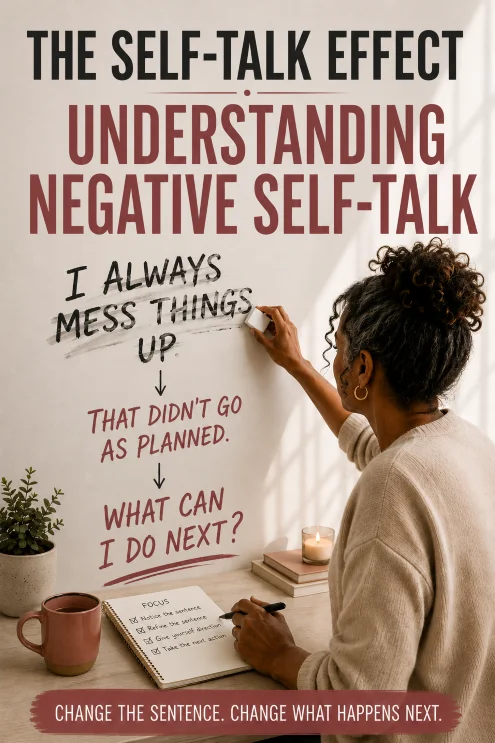
And the main question there to look at is, what if you spoke to yourself differently? What difference would that make in your life right now? Have you discovered a way to talk to yourself differently? So, if you repeatedly tell yourself that you're not capable or something's too difficult or you always get things wrong or you're not that sort of person, what if you thought about how that influences what you do next? And what happens when you start changing those sentences? So, instead of saying, "I can't do this," you say, "I haven't worked out how to do this yet." Or instead of saying, "I'm useless," you say, "I made a mistake, what can I learn from it?" They might seem like small differences, but they can change how you approach a situation. And when you start making different decisions, taking different actions, and responding differently, you begin creating different experiences.
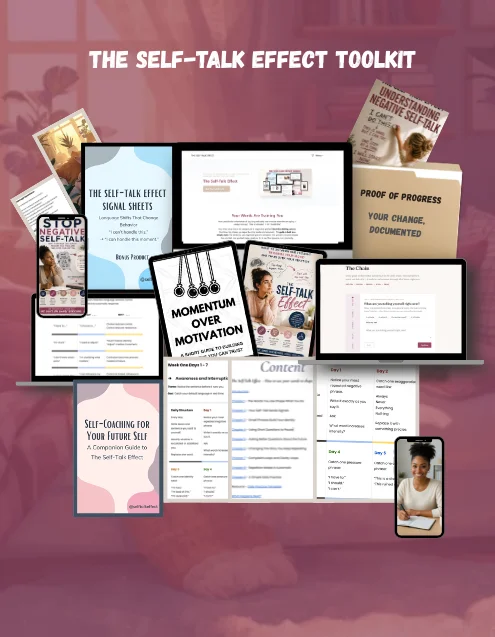
And this is what I want to explore here, because I genuinely believe that learning to recognize and change the way you talk to yourself is one of the most useful things you can do for your life. And I call that the Self-Talk Effect. And you can visit selftalkeffect.com, where I host some free resources that you can use to start working on your own self-talk.