By the third piece in this self-coaching thread, one thing became obvious to me, that the four questions, the five-step loop, and the way through a collapsed plan, none of them are hard to explain. What's hard is remembering they exist on an ordinary Tuesday, when nothing dramatic has happened, just the usual friction of getting through a day.
A reaction to catch in the moment or a stalled task to restart, maybe a plan that quietly failed, each of the last three posts here handled one specific moment. None of them answered what happens on the days when nothing that sharp shows up. That's the gap a practice is supposed to fill and it's the part most people skip because a technique is easy to read and a practice has to survive weeks where nothing forces you to use it.
In this guide: Why Knowing the Technique Isn't the Same as Having a Practice · The Three Checkpoints a Day Actually Has · What This Looks Like in Under Ten Minutes · Running the Same Method on a Schedule Instead of a Crisis · Practice This This Week · Where to Start
Why Knowing the Technique Isn't the Same as Having a Practice
The questions to ask before you react only work if you remember to ask them while you feel the annoyance or anxiety welling up inside you. The five-step loop only interrupts an afternoon of work if you catch it before the whole afternoon is gone. The way through a plan falling apart only helps if you catch the sentence about who you are before it hardens into a fact. Each one depends on noticing yourself mid-moment and mid-moment is the hardest time to remember anything.
A practice moves some of that noticing to a time when nothing is actually going wrong, you're not waiting for a difficult email or a stalled project to justify checking in with the sentence running your day. You're doing it on a schedule, the same way you'd check a bank balance before it's a problem, not after.
The Three Checkpoints a Day Actually Has
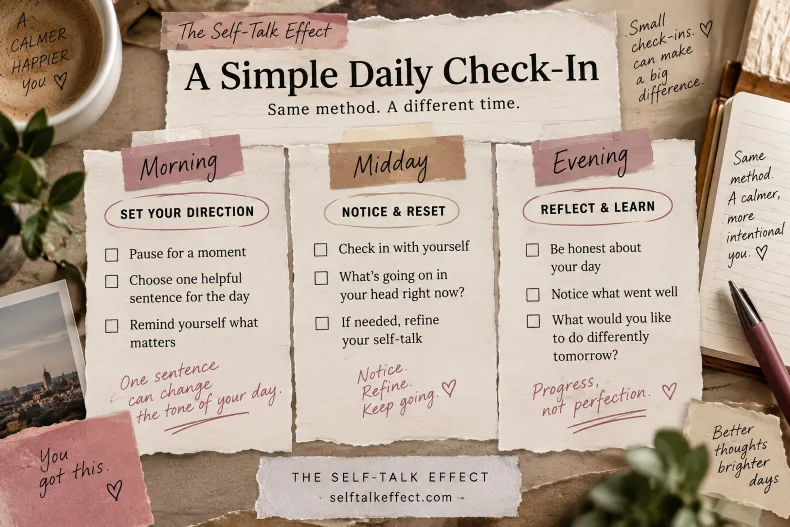
Most days already have three natural points where a quick look at your self-talk fits without adding a new task to your list.
Morning: choose the sentence you're opening with, on purpose. Before the day picks one for you, decide what you're telling yourself about it. Not a forced positive line, just something accurate you'd be willing to stand behind by lunchtime.
Midday: catch whatever sentence is actually running. This is the moment to ask the same question from the first post in this series: is this the situation in front of me, or an old sentence wearing a new one? You're not solving anything yet, just naming what's currently steering you.
Evening: review without criticism. Look back at one moment from the day and ask what sentence was running underneath it, the way the setback post separated what actually happened from what you decided it meant. This isn't a scorecard. You're not grading the day, you're just getting one piece of practice in before tomorrow starts.
What This Looks Like in Under Ten Minutes
The whole thing can run in under ten minutes total, spread across the day instead of stacked into one sitting. Morning gets two minutes: read the sentence you want to open with, out loud or on paper. Midday gets whatever time a pause actually takes, usually under a minute, because you're only naming the sentence, not solving it. Evening gets the last few minutes: one sentence about what ran the day, written down, no editing.
On a day when even that feels like too much, the smaller version from the five-step post still applies here: "I don't feel like it." "That's fine." "Start for five minutes." You're not committing to a full practice forever, just to the next five minutes of it.
Running the Same Method on a Schedule Instead of a Crisis
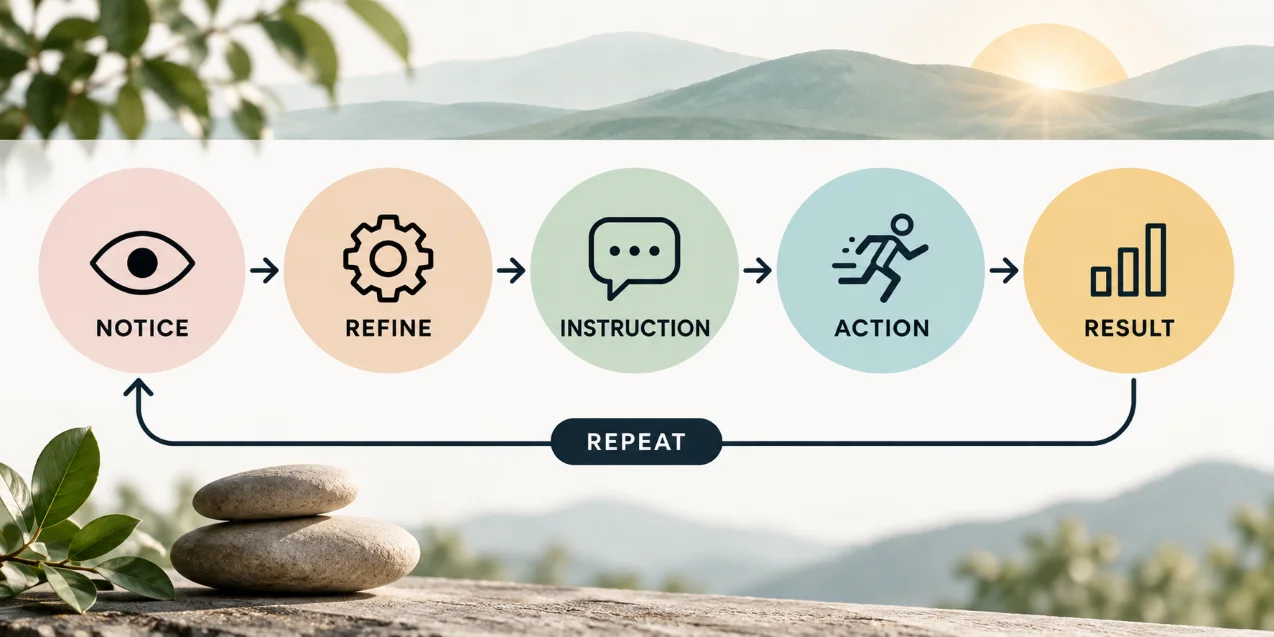
None of this replaces the Notice, Refine, Instruction, Action, Result loop. It just gives it somewhere to live outside a crisis. Notice becomes the midday checkpoint. Refine becomes the honest look you take in the evening. Instruction is the one sentence you choose each morning. The only thing that's changed is when you run it: on a schedule, not only when something has already gone wrong.
- Pick one fixed time for each checkpoint, morning, midday, evening, and put it somewhere you'll actually see it.
- Write down the sentence you open with tomorrow morning, before you check your phone.
- At your midday checkpoint, just name the sentence running. Don't fix it yet.
- At night, write one sentence about what actually happened today, separate from what you decided it meant.
- Do this for five days before deciding whether it's working. One day won't tell you anything.
If you're catching up on this series, Self-Coaching for Beginners lays out the full method the last three posts pull from. This one doesn't add a new technique to it. It just gives the technique three fixed times a day to show up, instead of leaving it to wait for the next hard moment.
If you want a free place to start building this, The Self-Talk Effect: Notice Your Negative Self-Talk is built for exactly the noticing part of this practice.