It's a Saturday afternoon and I've already told myself I want to watch TV and I've agreed with it, the way you agree with most of the sentences that run through your head without ever checking whether they're true or just convenient. I had a guide sitting half finished, the kind of project that only gets done if I sit down and do it, and the sentence in front of me had nothing to do with the guide. I just decided that I want to watch TV instead.
I have spent more over 25 years in personal development work, first through my own training then years of one-on-one coaching, and if there's one thing that experience has actually taught me, it isn't a technique. It's that I already have the tools I need most of the time. The only real question is whether I use them, or whether I forget to, the way most of us forget to on a Saturday afternoon when the guide can wait and the sofa can't.
So instead of going along with the sentence, I asked it a question. What will watching TV actually give me? Will it give me the life I want? Will it give me the sales I want? Knowing the answer made me get up, sit down at my desk, and finished the guide.
Nothing about that afternoon required more willpower than I had lying around. It required one interruption, at the right moment, in the shape of a question instead of an argument. That interruption has a structure to it, and once you can see the structure, you can use it on purpose instead of stumbling into it by accident the way I did that Saturday.
In this guide: Why Knowing Isn't the Skill You're Missing · The Loop Underneath the Saturday Story · The Smaller Version · Practice This · The Tools Were Never the Missing Part · Read the One Before This
Why Knowing Isn't the Skill You're Missing
If you're reading this, you probably already know what you should be doing and that was never the gap for me either. Knowing that watching TV wouldn't finish the guide changed nothing on its own, because knowing something and interrupting a pattern are two completely different skills, and most of us spend our energy on the first one rather than the second.
I learned this the long way, not the fast way. I grew up believing I was shy, because that's what I was told and what I told myself. In a room full of adults, I'd been raised to stay quiet unless spoken to directly. No joining conversations, no asking questions, just silence until someone addressed me, and I assumed that was simply how everyone operated. So in groups I stayed quiet, and quiet got labeled shy. One on one, with someone I trusted, I was a completely different person, chatty and quick and funny. I wasn't shy at all. I was conditioned, and conditioning and shyness look identical from the outside but they don't respond to the same fix.
Nobody was going to talk me out of that with a good argument, because I'd been raised to obey instruction, not question it. A statement like "you don't have to be this quiet" would have landed the same way every other instruction had landed for years, as something to comply with or resist, not something to actually think about.
What worked, eventually, was a question aimed at myself that I had to sit with and answer on my own terms, something closer to who decided you had to be this way. That's the reason questions run through everything I teach now. They don't push. They open a door and leave you to walk through it or not.
The Loop Underneath the Saturday Story
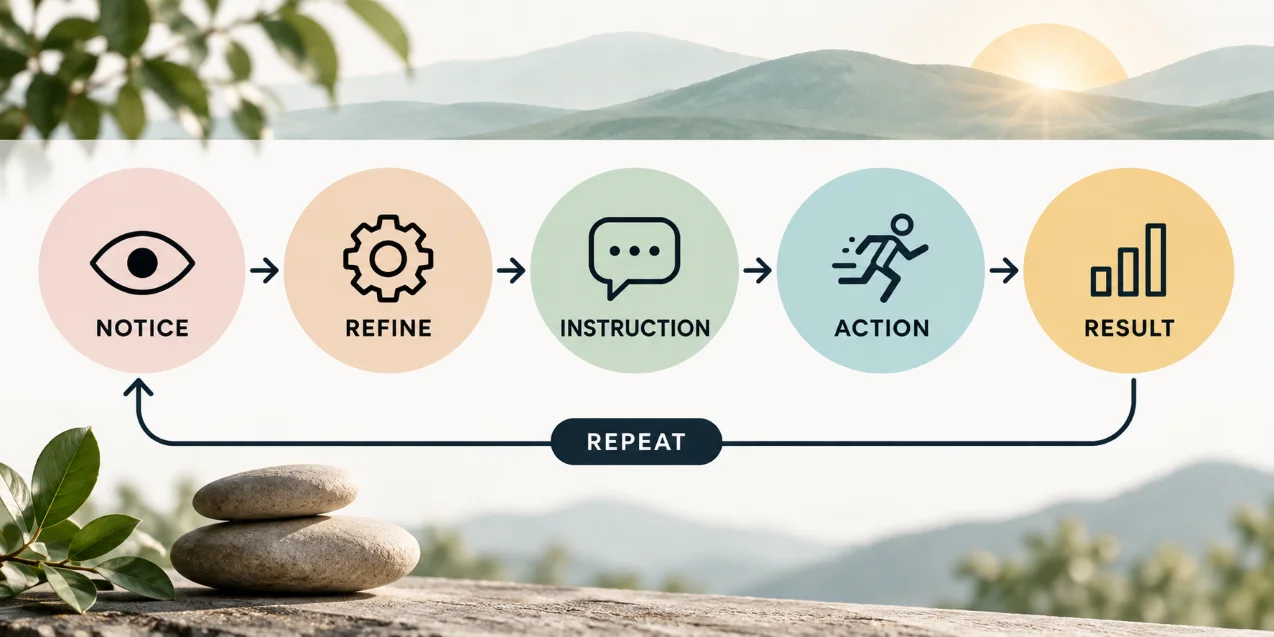
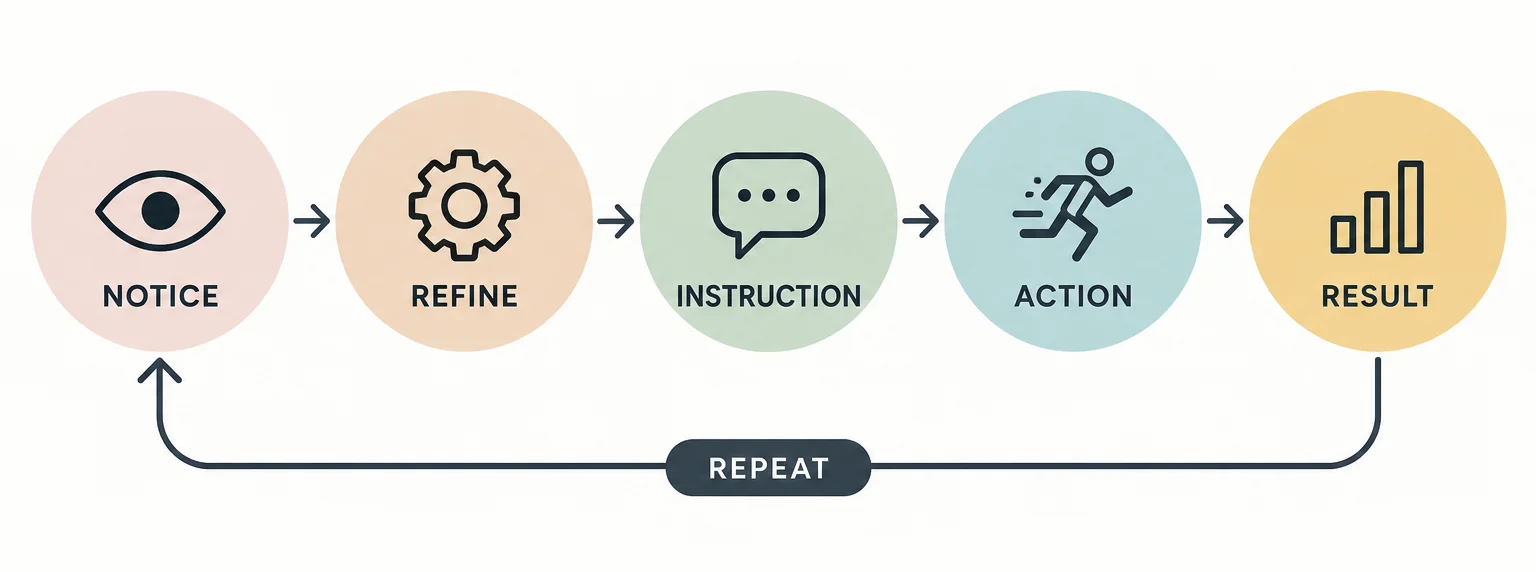
The method I built into the Stop Negative Self-Talk workbook has five words in it, Notice, Refine, Instruction, Action, Result, and it's easy to read that as a checklist. It isn't one. It's closer to a description of what actually happened on that Saturday, once I looked back afterward and asked myself what I'd actually done differently.
Noticing was the easy part, and it usually is because the sentence was right there, plain as anything: I want to watch TV and most people can catch a sentence like that if they're paying any attention at all. Where it usually falls apart is right after, in the gap between catching the sentence and doing anything about it, because catching it and believing it are the same thing unless you deliberately pull them apart.
That's what refining actually means. Not correcting the sentence, or arguing with it, just holding it up and asking whether it's the whole truth. I want to watch TV wasn't a lie because I did want to. But it wasn't complete either, because underneath it was a project I'd been avoiding, and the TV wasn't really about rest, it was about not having to face the guide for another few hours. Refining is the moment you stop taking a sentence at face value and start asking what it's actually doing for you.
The question I asked next did the job an instruction usually does, it got me moving. Get up and do the work. Stop making excuses. None of that has ever worked on me for more than a day, because I was conditioned to resist being told things, even by myself. What actually moves me is a question I have to answer honestly. What will this give me. Will it give me the life I want? Those two questions did more work in that moment than any pep talk could have, because I had to produce the answer myself, and once I had it, there wasn't much of an argument left to have.
Action followed almost immediately, which is usually how it goes once the instruction has actually landed. I didn't sit with the decision for an hour. I got up. And the result wasn't just a finished guide, it was proof I could point back to later that the tools I already had were still there and still worked, once I actually used them.
The Smaller Version, For When the Saturday Version Feels Like Too Much
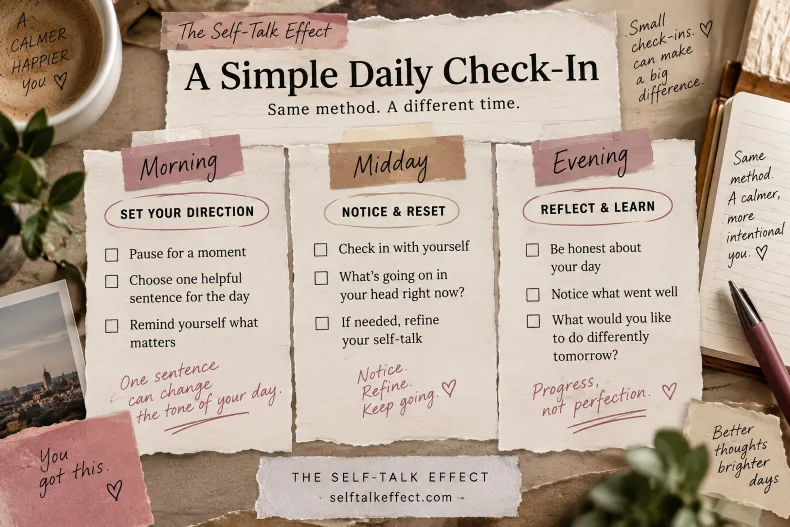
You don't need a whole guide sitting unfinished to use this. The guide itself teaches a shorter version, just three lines: "I don't feel like it." "That's fine." "Start for five minutes." The second line is doing something important. It's not arguing with you or trying to talk you out of not feeling like it. It just doesn't let that feeling be the one making the decision. Then the instruction that follows is small on purpose. Five minutes is easy to agree to, and once you've started, you usually keep going past it.
Practice This the Next Time You Catch Yourself Stalling
- Write down the exact sentence you're thinking.
- Ask yourself one specific question about what that sentence is actually offering you right now, instead of a vague "should I do this."
- Decide on the smallest possible instruction you could follow in the next two minutes.
- Do that one small thing before you decide anything else, including whether you feel like it.
The Tools Were Never the Missing Part
I didn't learn anything new on that Saturday. Every tool I used was already mine, built over years of training and coaching other people through exactly this. The only thing that changed was whether I used it in that specific moment, instead of letting the easier sentence run the afternoon. That's usually where the real gap sits, not in what you know, but in whether you catch the sentence in time to ask it a question.
This is the second piece in the self-coaching thread on this site. If you haven't read The Self-Coaching Questions to Ask Before You React, that's the one this builds on.
The full version of this method, with all five steps and space to practice each one, is in The Self-Talk Effect: Stop Negative Self-Talk. If you want the free place to start, that's The Self-Talk Effect: Notice Your Negative Self-Talk.