My plan in the early 2000s was to build towards becoming a motivational speaker. I was running my life coaching business and every choice I made led me towards more stages and rooms filled with people listening to what I had to say. I remember one parents evening that had me really shaking in my boots, but that's a story for another time.
During this period I really believed that my plan was set and all there was left to do was work the plan and make myself known. Then I twisted my pelvis and spent the next eighteen months barely able to sit through a meeting, let alone stand on a stage.
I had been paying for personal indemnity insurance for years for this exact purpose, so I wasn't worried. I completed the claim form and was totally shocked when the insurer refused it. They had decided that an old, unrelated injury made my claim void. As I had paid for several years of insurance up front I cancelled it and got what was left of my money back and then leaned on my savings. Then credit cards. Until there was nothing left to lean on. I picked myself up and got myself back to work.
The second wave to hit my plans
A few years later the 2008 recession landed and I watched as clients vanished and businesses that owed me from unpaid invoices went under. I was already recovering financially from the injury and now I was once again hitting the savings only it went dry far faster this time.
My plan to become a motivational speaker didn't just stall. It ended. During this time something else had shifted. The sentence running in my head. It had gone from "this is a setback" to "this always happens to me"
That's what can happen when a plan collapses. What you say to yourself changes, sometimes without you even noticing, and whatever I was telling myself decided whether I would spend the next few weeks fixing the issue or collecting evidence that I was never going to make it anyway, because life is just not fair.
Why we can sometimes reach for the wrong sentence first
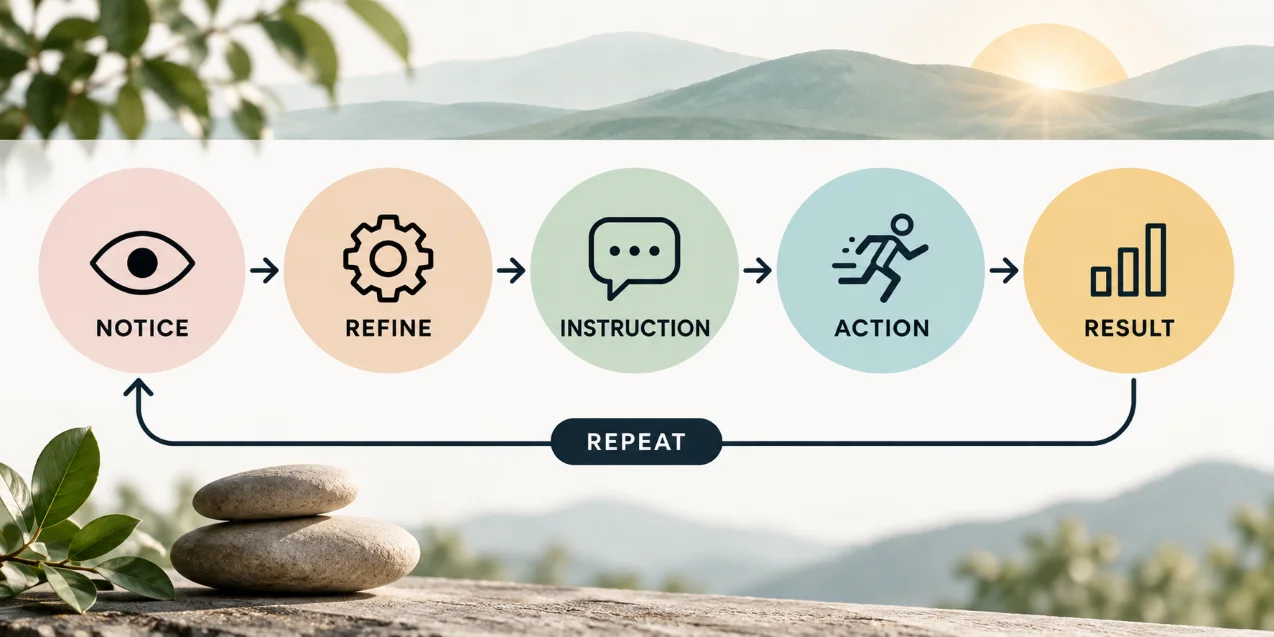
I have found that self-talk runs in a fixed order of sentence first, then the feeling it products, followed by what to do next and finally the result that produces. So, when a plan falls apart, that first sentence usually arrives before you have even registered that you are speaking to yourself at all.
That's because a collapsed plan leaves a gap and our mind doesn't like gaps so it fills it in fast. The fastest thing to fill a gap with is usually a conclusion about you as a person, since that's a file already open. The insurance claim was refused, this is a fact about one company's decision. "This always happens to me" is a conclusion about who I am. The second one feels true in the moment because it arrived quickly, not because it's accurate.
What most people do instead, and what to actually do instead
The mistake in this story isn't feeling the disappointment. It's letting the sentence about this setback quietly become a sentence about me, then treating that sentence as a settled fact instead of something I just said during a difficult time.
It's an easy thing to do, you can turn "the plan failed" into "I failed" and go back to your past for every other time something didn't work out to use as evidence that this was always going to happen. Or you might find yourself freezing entirely while you wait to feel ready to decide anything.
The way out of reaching for an incorrect sentence isn't a bigger does of positivity. It is four smaller steps, in order that will help you stop negative self-talk.
The first is to notice the sentence you actually said, write it down or say it out loud (or in your head), then refine it, separating what actually happened from what you have decided it means about you. Then give yourself an instruction, one small specific thing to do next. Finally take that action, before feeling has a chance to tell you that you're not ready and talk you out of it.
Here's what that looked for me, years apart from each other starting in 2008 when my sentence started with "I'm never going to recover from this" and I didn't have the technique I have now for interrupting it, so I didn't interrupt it. I just kept moving because I had no other option. If that happened to me now, the sentence I would catch and refine would be "the claim was refused" and that's it, full stop, that is the fact. I would then find out what the appeal process requires and chase that company for what they promised me - money when I couldn't work due to illness. It would have been the same setback but a completely different set of actions.
One thing to actually do next time a plan falls apart
This is something I recommend clients do when they go through a challenging time. First write down what actually happened, in plain facts, with no character judgment attached and then what they are tempted to make that mean about who they are a person.
Put both on a page and look at them side by side. The first one is usually short and true but the second one is usually longer, older and not actually about what happened. Yes you scored low on a test or your client cancelled or your insurer said no - these are all facts. None of them mean anything about you as a person.
If you want a shorter version of that same instruction for whenever a moment arises where your plans change and you are looking to use self-coaching to help you through it, the Self-Talk Effect's six-word shifts are built for exactly that. Pick the one that fits in your situation and repeat it as many times as the old sentence tries to return.
The plan was the easy part of rebuild
The insurance claim was never approved and some of the recession-era money was never paid, but a plan is replaceable. You can build another one, and most people do, I certainly did. What can be harder to recover from is quietly deciding you are the kind of person plans fall apart on. That's the sentence worth catching, because it's the one still running years after the actual event stopped mattering.
Start with the guide that started this
If a plan of yours didn't hold this week and you want to learn how to self-coach your way back into action the Take Control Of Your Self Talk Toolkit can help you with that. It's build for exactly this moment and will take you through how to catch the sentence before it runs the rest of your week, month or years. Learn how to question your thought and redirect toward the next action.